
What Is an AI Image Generator From Text?
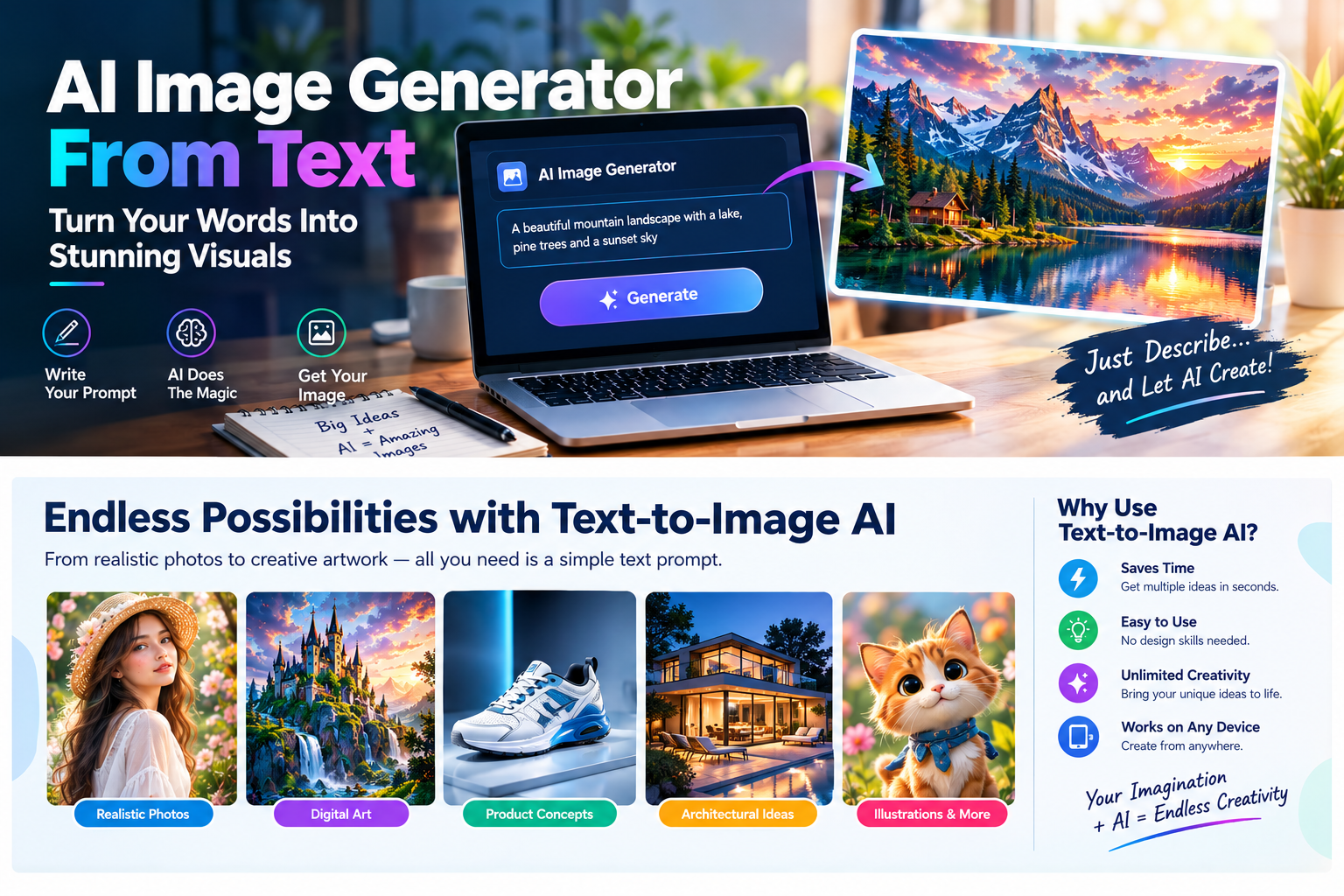
An AI Image Generator From Text is a technology that allows users to create images simply by describing what they want in written words. Instead of drawing an image manually or searching through stock-photo websites, users can enter a text prompt describing a person, place, object, scene, style, or concept, and artificial intelligence generates a visual based on that description. These tools have made image creation much more accessible because users do not necessarily need professional photography equipment or advanced graphic design skills. A simple idea can be transformed into a digital image within a short period of time. Text-to-image technology is now used for creative projects, blog illustrations, social media content, marketing concepts, presentations, educational materials, product ideas, and many other visual tasks.
How Does Text-to-Image AI Work?
Text-to-image AI uses sophisticated machine-learning models that have been developed to understand relationships between language and visual information. When a user enters a prompt, the system analyzes the words and identifies important details such as the subject, environment, composition, style, colors, lighting, and overall mood. The AI then uses those instructions to create an image that attempts to match the requested concept. Different platforms use different models and generation methods, so results can vary considerably between tools. Some systems can create multiple image variations from one prompt, while others provide additional controls for image size, aspect ratio, style, editing, and reference images. Although the underlying technology is complex, the user experience can be very simple: describe an idea, generate an image, review the result, and refine the instructions if necessary.
From Simple Words to Visual Content
The most interesting part of text-to-image technology is that users can start with an idea rather than an existing image. A prompt such as “a peaceful mountain village during sunset” provides the AI with a concept that it can interpret visually. Adding details about lighting, weather, architecture, colors, camera perspective, or artistic style can give the system additional guidance. This makes text-based image generation useful for both simple and highly creative visual projects.
Why Use an AI Image Generator From Text?
One of the main reasons people use text-to-image AI is speed. Creating a custom visual manually can take significant time, especially when several versions are required. AI can help users explore different ideas quickly and produce multiple concepts from different prompts. Another advantage is accessibility. Someone who does not know how to use professional design software can still experiment with visual creation by describing an idea in natural language. AI image generators can also provide flexibility because users are not limited to the photographs or illustrations already available in a stock library. They can request a specific environment, atmosphere, composition, or creative concept and then adjust the prompt until the result is closer to what they need.
How to Write an Effective Text-to-Image Prompt
The prompt is one of the most important parts of the image-generation process. A short prompt can produce an interesting result, but a well-structured prompt can give the AI more useful information. Start by identifying the main subject of the image and then describe the environment or background. After that, add important details about lighting, mood, composition, colors, perspective, and visual style. For example, instead of writing “a futuristic city,” you could describe “a futuristic city at night with illuminated skyscrapers, flying vehicles, reflective streets, cinematic lighting, and a realistic atmosphere.” This type of prompt gives the AI a clearer idea of the intended scene. However, adding too many unrelated instructions can sometimes make the result less consistent, so it is useful to focus on the details that matter most.
Important Elements of a Good Prompt
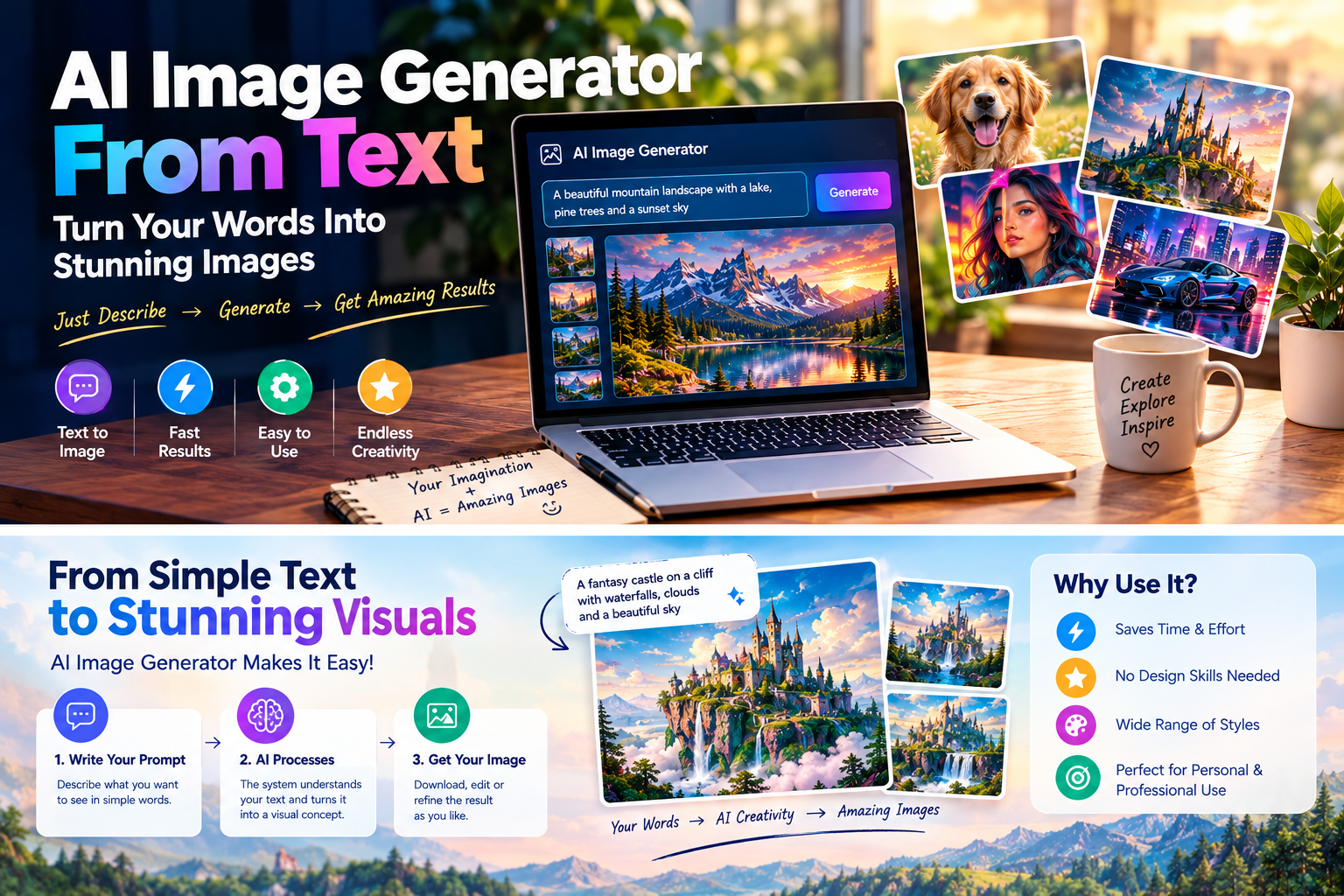
A useful prompt can include several elements: subject, environment, action, lighting, composition, style, mood, and visual details. You do not always need to include every element. The goal is to communicate the most important aspects of the image clearly. If the image needs to look realistic, mention a realistic or photographic appearance. If you want an illustration, describe the desired artistic style. You can also specify whether you want a close-up, wide shot, overhead view, portrait composition, or another perspective.
AI Image Generator From Text for Bloggers
Bloggers can use text-to-image generators to create custom visuals for articles and website content. Instead of relying entirely on generic stock images, a blogger can generate an illustration specifically related to the topic of an article. For example, a technology blog could create an image showing a futuristic AI workspace, while a travel website could generate a conceptual landscape representing a destination. Custom visuals can also make articles more visually engaging when they are placed naturally between sections. However, website owners should always check the terms of the AI platform they use, particularly if the generated images will be used commercially. It is also important to review every generated image before publishing it because AI-generated visuals can sometimes contain unexpected details or inaccuracies.
AI Image Generator From Text for Social Media
Social media creators can use text-to-image AI to develop original backgrounds, promotional visuals, creative artwork, post graphics, and content concepts. The ability to generate an image from a short description can be especially useful when creators need visuals for multiple posts. A creator might generate a futuristic background for a technology post, an artistic scene for an inspirational quote, or a product-style composition for a promotional concept. Many AI tools also provide different aspect ratios, which can make it easier to create visuals for different platforms and content formats. Instead of creating every visual from scratch, creators can use AI to generate an initial concept and then make additional edits using image-editing software.
Creating Consistent Visual Content
Consistency is important for websites and social media pages. When using AI-generated images, creators can develop a recognizable visual direction by repeatedly using similar descriptions, lighting styles, compositions, and artistic approaches. While exact consistency can depend on the AI model and available features, maintaining a clear prompting style can help create a more unified collection of visuals.
AI Image Generator From Text for Businesses
Businesses can also benefit from text-to-image generation. Marketing teams can use AI to brainstorm advertising concepts, website visuals, campaign ideas, presentation graphics, and product scenes. Small businesses may find these tools particularly useful when they need creative concepts without having access to a large design team. For example, a business could describe a professional product display with specific lighting and background requirements and use the generated image as an early concept for a marketing campaign. AI can also help teams quickly explore several creative directions before deciding which concept deserves further development. However, businesses should carefully review platform licensing terms and should not assume that every generated image automatically has unrestricted commercial-use rights.
Best Types of Images to Create With Text-to-Image AI
Text-to-image generators can produce a wide variety of visual concepts. Users can create landscapes, fictional environments, illustrations, abstract artwork, product concepts, architectural ideas, backgrounds, educational graphics, and many other types of images. The technology can be especially useful when the requested image is difficult to photograph or does not exist in the real world. A creator could visualize an imaginary planet, a futuristic building, a fantasy environment, or a fictional machine simply by describing it. At the same time, the quality of results depends on the AI model and the complexity of the request. Simple scenes may be easier for some systems to generate accurately, while complicated compositions containing many specific elements may require several attempts and prompt adjustments.
Realistic and Artistic Images
Users can generally guide the appearance of an image by describing its desired style. Words such as realistic, cinematic, photographic, illustrated, watercolor, or 3D can help communicate the intended visual direction. The exact results vary by platform, so experimenting with different descriptions is often necessary.
Free AI Image Generator From Text
Many users specifically look for a free AI Image Generator From Text because they want to experiment without paying for a subscription. Some platforms provide free generations, although the available number of images, processing speed, resolution, or advanced features may be limited. Free access can be suitable for beginners who want to learn how text-to-image generation works. Users who create images frequently may eventually need a paid plan for higher limits or additional features. Before choosing a service, it is important to check its current pricing, generation limits, image resolution, and usage conditions. A service being free does not necessarily mean that every generated image can be used for every commercial purpose, so users should always read the relevant terms before publishing important content.
Advantages and Limitations of Text-to-Image AI
Text-to-image AI provides several advantages, including fast creation, creative flexibility, accessibility, and the ability to explore ideas that would otherwise require significant design resources. It can help users create visual concepts even when they do not have professional artistic skills. However, the technology also has limitations. AI-generated images may sometimes contain incorrect objects, inconsistent details, unnatural compositions, or other visual problems. Text within generated images can also require additional attention, depending on the tool. Results are not always predictable, and the same prompt may produce different outcomes. For these reasons, users should review generated images carefully rather than publishing every result without inspection. AI works best when it is treated as a creative assistant that can generate ideas and starting points while the user remains responsible for reviewing and refining the final result.
Tips for Getting Better AI-Generated Images
Getting better results usually requires experimentation. Start with a clear description of the main subject and then add only the details that are important to the final image. If the first result is not correct, identify what needs to change and modify the prompt accordingly. You can experiment with different descriptions of lighting, perspective, environment, composition, and style. It can also be useful to generate several variations rather than relying on the first output. Keeping a collection of successful prompts can save time when creating similar images later. Most importantly, remember that different AI image generators interpret language differently. A prompt that produces an excellent result on one platform may require adjustments on another. Learning how a particular tool responds to wording is therefore an important part of becoming better at AI image generation.
Future of AI Image Generation From Text
The future of text-to-image technology is likely to include more precise image control, improved realism, better consistency, advanced editing, and deeper integration with other creative tools. Users may increasingly be able to modify individual parts of an image while preserving the rest of the composition. Improvements in character consistency, typography, object placement, and image editing could make AI-generated visuals more useful for professional workflows. Text-to-image systems may also become more conversational, allowing users to describe changes naturally rather than adjusting complicated settings manually. As these technologies continue to develop, prompt writing, visual editing, and the ability to evaluate AI-generated content will become increasingly useful skills for creators and businesses.
Final Thoughts
An AI Image Generator From Text provides a simple way to transform written ideas into visual content. Whether you are a blogger, social media creator, designer, student, marketer, or business owner, text-to-image AI can help you explore concepts and create customized visuals much faster than many traditional methods. The quality of the final image depends on the chosen tool, the prompt, and the amount of refinement applied to the result. For beginners, the best approach is to start with simple prompts, experiment with different descriptions, and gradually learn which instructions produce the desired results. As AI image-generation technology continues to evolve, text-based image creation is becoming an increasingly practical part of modern digital creativity.