
Best AI Image Generators in 2026
Artificial intelligence has changed the way people create digital images. A few years ago, producing a professional-looking image usually required photography skills, graphic design software, or a professional designer. Today, AI image generators can turn a simple text description into an impressive visual within seconds. Whether you want realistic photographs, digital artwork, illustrations, product images, social media graphics, or creative concepts, AI-powered tools can make the process much easier. The best AI image generators are becoming useful for designers, content creators, marketers, students, businesses, and anyone who wants to experiment with visual content without spending hours learning complicated software.
What Is an AI Image Generator?
An AI image generator is a software tool that uses artificial intelligence models to create images based on instructions provided by a user. These instructions are commonly called prompts. A user can describe a scene, character, object, environment, or artistic style, and the AI system attempts to generate an image that matches the description. Some tools can also transform existing images, remove objects, expand backgrounds, change styles, or create variations of an original picture.
How AI Image Generation Works
Most modern AI image generators rely on advanced machine-learning models trained on large collections of visual data. When you enter a prompt, the system analyzes the words and converts the description into information that its image model can understand. It then generates visual content based on patterns learned during training. The quality of the result depends on several factors, including the AI model, prompt quality, image settings, and the type of image you are trying to create. Better tools generally provide greater control over composition, style, resolution, and other visual characteristics.
Why Use AI Image Generators?
The biggest advantage of AI image generators is speed. A person can spend hours searching for the right stock image, while an AI tool may produce several customized concepts in a short time. AI generators can also help people who do not have advanced design skills. Instead of manually creating every element, users can describe what they want and allow the AI to handle much of the visual creation process.
Another important advantage is customization. Traditional stock images may not perfectly match your requirements, but an AI-generated image can be created around a specific idea. For example, a business could generate a product concept with a particular background, lighting style, and composition. Content creators can also use AI tools to develop visual ideas for blogs, videos, presentations, and social media campaigns.
Best AI Image Generators to Try
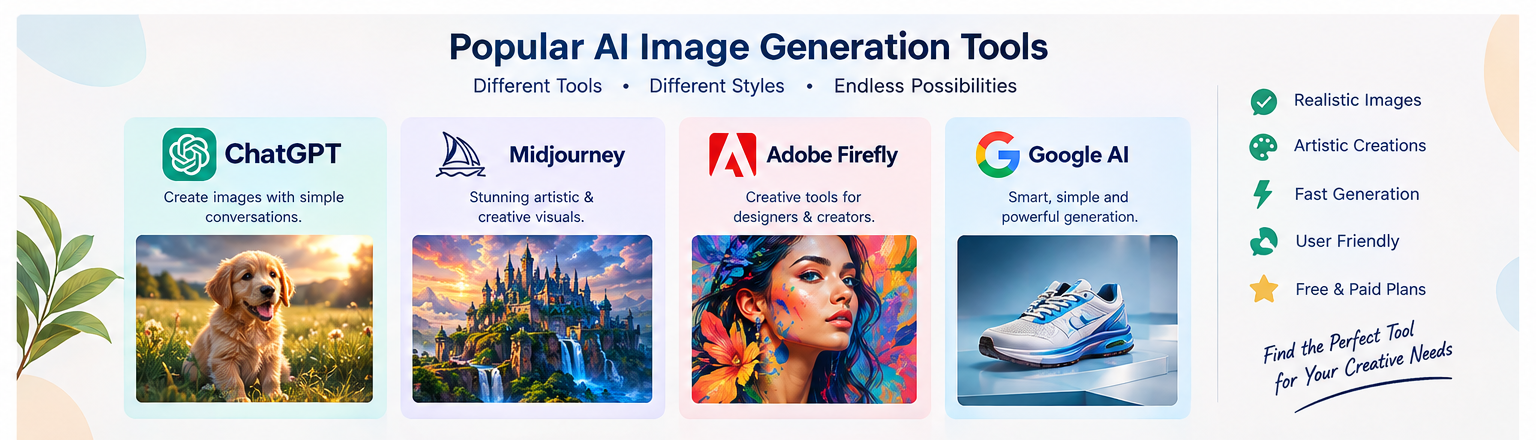
There are many AI image generation platforms available today, and each one has different strengths. Some focus on photorealistic results, while others are better for artistic images, creative experimentation, design workflows, or editing. The right choice depends on what you need to create, how much control you want, and whether you prefer free or paid features.
ChatGPT Image Generation
ChatGPT can be useful for people who want to create images while working through an idea conversationally. Instead of learning a complicated interface, users can describe the desired image in natural language and refine the concept through follow-up instructions. This can be particularly helpful when you want to change details such as the composition, atmosphere, objects, text placement, or visual style.
Its conversational approach makes it attractive for beginners as well as users who want to experiment quickly. It can also help develop prompts and creative concepts before generating an image.
Midjourney
Midjourney is widely recognized for its strong artistic capabilities and visually impressive results. It is particularly popular among people interested in concept art, fantasy scenes, cinematic visuals, illustrations, and highly stylized compositions. Users can experiment with prompts and settings to produce distinctive visual results.
One of Midjourney’s major strengths is its ability to create images with a strong artistic appearance. It can be a good choice for designers, artists, creators, and anyone looking for visually striking concepts rather than simple everyday graphics.
Adobe Firefly
Adobe Firefly is designed with creative workflows in mind and is especially useful for people already working with Adobe’s ecosystem. It provides AI-powered image generation and editing capabilities that can support tasks such as creating visual concepts, generating backgrounds, and modifying images.
One advantage of an integrated creative platform is that AI features can become part of a larger design workflow. Instead of treating AI generation as a separate activity, users can combine generated content with other editing and design tools.
Google Image Generation Tools
Google also offers AI-powered image generation capabilities through its generative AI products. These tools are useful for users who want to experiment with text-to-image creation and other AI-assisted creative workflows. Google’s ecosystem can be particularly convenient for people already familiar with its AI services.
As AI image technology continues to develop, Google’s models and creative features are also evolving. Users should check the currently available features, usage limits, and regional availability before choosing a specific Google AI image tool.
How to Choose the Best AI Image Generator
Choosing the best AI image generator is not simply about selecting the tool that produces the most attractive image. Different projects require different capabilities. Before choosing a platform, consider the type of images you want to create, the level of control you need, and your available budget.
Image Quality
Image quality should be one of your first considerations. If you need realistic people, environments, products, or professional marketing visuals, look for a tool that consistently produces detailed and convincing results. For illustrations or creative artwork, artistic quality and style flexibility may be more important than photorealism.
Ease of Use
A powerful AI model is not very useful if the interface is difficult to understand. Beginners may prefer platforms where they can simply describe their idea and generate an image. More experienced users may prefer advanced controls that allow them to adjust composition, style, aspect ratio, variations, and other parameters.
Pricing and Free Options
Cost is another important factor. Many AI image generators offer free access with limitations, while advanced features may require a subscription or credits. Before paying for a service, check what the free version includes and whether its commercial-use terms fit your project.
How to Write Better AI Image Prompts
The quality of an AI-generated image often depends heavily on the prompt. A vague prompt such as “a beautiful city” gives the AI considerable freedom to interpret the request. A more specific prompt can provide information about the subject, environment, lighting, camera perspective, mood, composition, and visual style.
Include Important Visual Details
When writing a prompt, clearly explain what should appear in the image. Mention the main subject first, then provide details about the environment and desired appearance. You can also describe lighting, colors, perspective, atmosphere, and composition when those details matter.
For example, instead of simply requesting a “modern office,” you could describe a bright modern office with large windows, contemporary furniture, natural daylight, indoor plants, and a clean professional atmosphere. Specific information gives the AI more guidance and can make the resulting image closer to your original concept.
AI Image Generators for Different Purposes
AI image generation is not limited to artistic experiments. These tools are increasingly being used for many practical purposes. Bloggers can create custom illustrations for articles, while social media creators can develop original visuals for posts and campaigns. Businesses can explore product concepts and advertising ideas without immediately hiring a designer for every early-stage concept.
For Content Creators
Content creators can use AI image generators to create thumbnails, backgrounds, illustrations, characters, and visual concepts. This can make it easier to maintain a consistent visual style across different pieces of content.
For Businesses
Businesses can use AI-generated visuals for brainstorming, marketing concepts, presentations, advertisements, and product visualization. However, businesses should always review the licensing and commercial-use terms of the particular AI service before using generated images commercially.
For Designers
Professional designers can use AI as a creative assistant rather than a complete replacement for their workflow. AI can help generate initial concepts, explore different directions, produce variations, and speed up repetitive creative tasks. Designers can then refine the results using traditional editing software.
Advantages and Limitations of AI Image Generators
AI image generators offer several advantages, including speed, accessibility, creativity, and customization. They can help users turn ideas into visual concepts without requiring advanced artistic skills. They are also useful for brainstorming because a single concept can often be explored in many different visual directions.
However, AI generation also has limitations. Results may sometimes contain incorrect details, unusual compositions, inconsistent objects, or other visual problems. Text inside generated images can also be challenging for some models. In addition, users should understand the platform’s terms regarding copyright, commercial usage, privacy, and generated content before publishing important work.
Are AI Image Generators Free?
Some AI image generators provide free access, but “free” does not always mean unlimited. A free plan may include a limited number of generations, slower processing, lower resolution, watermarks, or restricted features. Paid plans may offer higher limits, faster generation, additional editing features, and better access to advanced models.
For occasional users, a free plan may be enough. People generating images regularly for websites, businesses, or professional projects may find a paid plan more practical. Always compare the current plans and usage conditions before subscribing.
The Future of AI Image Generation
AI image generation is developing rapidly, and future tools are likely to become more accurate, controllable, and integrated into everyday creative software. We can expect improvements in realistic details, character consistency, image editing, typography, video integration, and creative control.
The technology is also making visual creation more accessible. Someone with an idea but limited design experience can now experiment with concepts that would previously have required specialized skills. At the same time, responsible use will remain important. Users should pay attention to copyright, consent, originality, platform policies, and the appropriate use of AI-generated content.
Final Verdict
The best AI image generators are not necessarily the same for everyone. A tool that works perfectly for artistic illustrations may not be the best option for realistic product photography or professional design. ChatGPT can be useful for conversational image creation, Midjourney is well known for creative and artistic results, Adobe Firefly can fit naturally into design workflows, and Google’s AI tools provide another option for users interested in generative image technology.
Before choosing a platform, consider image quality, ease of use, available features, pricing, generation limits, editing capabilities, and usage rights. It is also worth testing several tools because the same prompt can produce very different results across different AI models. As the technology continues to improve, AI image generators will likely become an even more important part of digital creativity, helping individuals and businesses turn ideas into engaging visuals faster and more efficiently.